Users and positioning
Review customers, scenarios, needs and competitors. Separate facts from assumptions, and define whose problem the product solves and how it connects to strategy.
Reading Appearance
Location is used only with your permission and stored locally.
Brand Services
Product Planning
Define positioning, value, feature priorities and iteration around users, scenarios and business objectives. Discuss business rules, workflows, interfaces, technical dependencies and post-launch support together, giving design and development a verifiable starting point.
Understand the question first, then agree the scope together.
Businesses, brands and project owners preparing products, upgrading systems or turning business and governance rules into digital tools.
I undertake product research, business structuring and requirements prioritization, coordinating handover across design, technology and operations. Agreed teams carry out design, development, testing and ongoing support; the business confirms rules, data, budgets and acceptance.
Choose a service around the actual question. The scope and outputs depend on what we agree together.
Review customers, scenarios, needs and competitors. Separate facts from assumptions, and define whose problem the product solves and how it connects to strategy.
Translate value, payment, revenue, costs, incentives and rights into product mechanisms. Verify budgets and fulfillment conditions so features align with operating capacity.
Define roles, permissions, workflows, content, data and exceptions. Set the initial release and iteration priorities, documenting dependencies and responsibilities for accounts, digital rights and interfaces.
Organize architecture, copy, prototypes and acceptance criteria, connecting brand and visual expression. Design and technology teams produce outputs; I coordinate review and handover. Development, launch, source code and versions are confirmed separately.
Plan instructions, help, feedback, monitoring and upgrades, with service windows and responsibilities. Operations, support and development teams execute ongoing work and arrange iterations using data and feedback.
WORK SAMPLES
Explore diagrams, research arguments, sample files and work records connected to these services. Read the sources and inspect the tools to judge their relevance to your question.
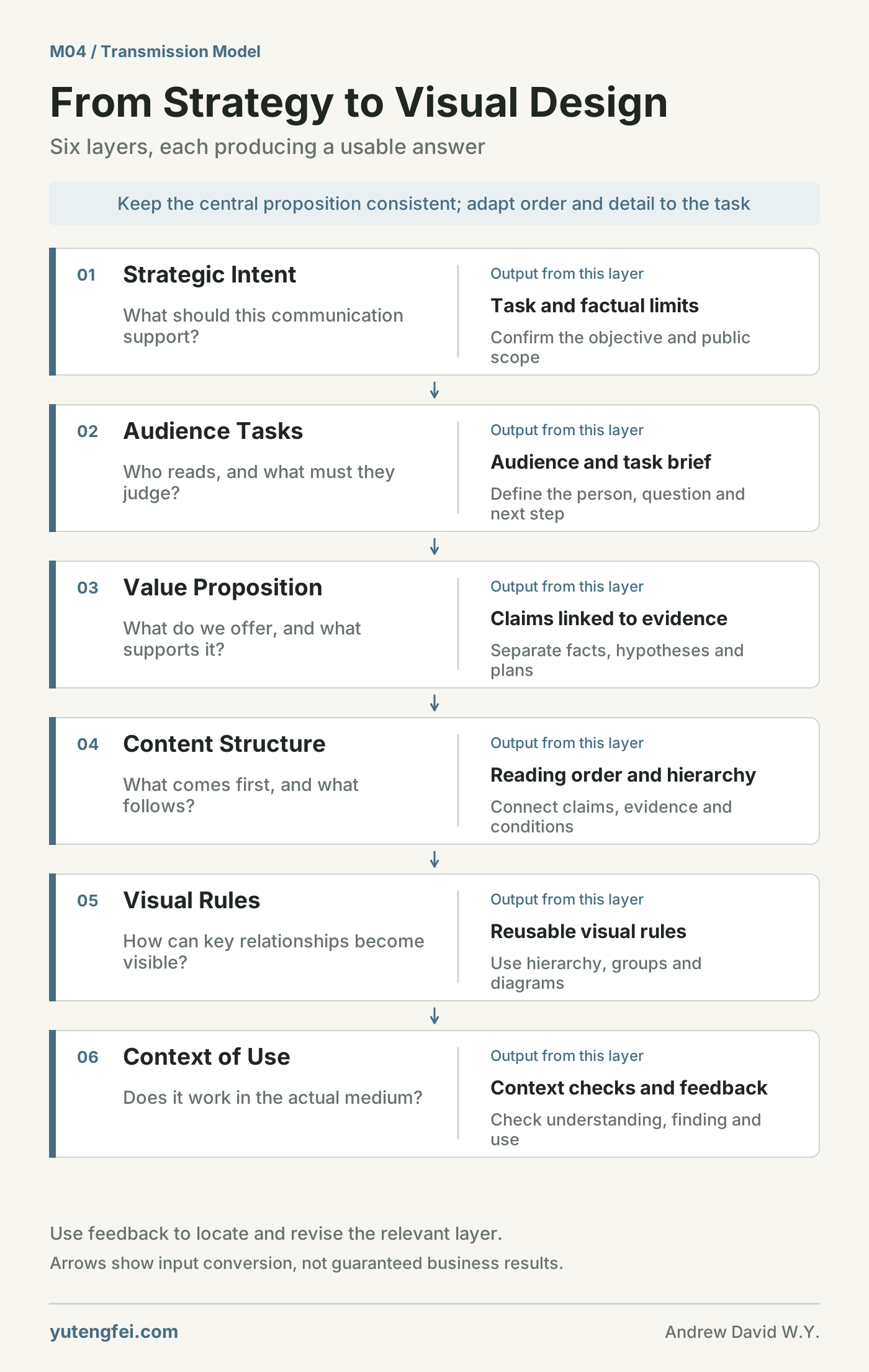
Research argument · source excerpt
Each layer should address the question passed down from the previous one and provide a usable answer for the next. The answers are then checked in the setting where the work will actually be used. This is a working model for organizing and reviewing design decisions.
From Strategy to Visual Design: How Do Six Layers Carry the Same Meaning? Revised · V1.0
The method sets out reference steps; this collection does not present results from a real pilot.
Reference workflow · Product Planning
These are reference steps for the service; the actual scope and outputs are agreed before work begins.
The completed items are public files and tool samples; this does not establish acceptance of a client project.
Confirm users, objectives, information and system foundations.
Confirm rules, priorities, data and interfaces.
Design, technology and business teams review workflows, outputs and acceptance.
Document versions, support responsibilities and validation tasks.
Plans and prototypes inform implementation. Responsible teams confirm software, interfaces, launch, operations and specialist activities. Documents do not automatically grant access to third-party platforms or accounts.
Yes. Review workflows, feedback, interfaces and teams, then agree retained capabilities and improvements.
Planning establishes requirements and handover. Prototypes, interfaces, development, deployment and support can be combined, with separate teams, fees and acceptance criteria.
Compare user needs, value, resources and dependencies. Validate assumptions before expanding; quantities and versions are confirmed in the project.
Start a conversation
Understand the question first, then agree the scope together.
A brief overview is enough for the first email. Detailed materials can follow once we agree how to proceed.